You already know your neighbourhood too well. That is the problem, and also the opportunity. The route to the shop, the loop around the park, the street where you always turn left because you have never once turned right — after a few hundred passes, the brain files all of it under "already seen" and stops reporting back.
But those streets are full of material you have been walking past for years. A walk designed for collecting ideas is not about finding somewhere more interesting to go. It is about giving your attention a job, so the ordinary stuff starts showing up again.
Start With the Dullest Route You Know
Novelty gets too much credit. A street you have never seen gives you plenty to look at and nothing to compare it with. A street you have walked a thousand times gives you change: the shop that has had three owners in two years, the handwritten notice that has gone from white to yellow, the crack in the pavement outside number 12 that has quietly become a small hole.
Ideas rarely arrive from spectacle. They come from noticing that something small has shifted, or that something you assumed was permanent is being held together with cable ties.
So pick a loop of fifteen to twenty minutes that you could walk half asleep. Then change one variable: walk it in the opposite direction, or at an hour you never use, or stop every time you would normally keep going. That is the entire setup. No special equipment, no destination.
Give Yourself a Brief Before You Go
Without a brief you come back with "nice walk". With one, you come back with material. A brief is a single sentence, not a project, and it should be narrow enough that you can visibly succeed or fail at it.
- Find three things in the wrong colour for their surroundings.
- Copy the exact wording of every handwritten sign you pass.
- Look only for repairs: tape, mismatched bricks, new padlocks, a plank over a puddle.
- Find five objects that suggest somebody's daily routine — a chair left out, a bowl, a pair of boots by a door.
- Spend the whole walk looking at edges: kerbs, thresholds, fences, drain covers, the joins between buildings.
- Count how many different languages, fonts and materials appear in a single hundred-metre stretch.
One brief per walk. "Notice everything" is not a brief; it is a mood. Rotate through your list over a few weeks and you will find that each one pulls a completely different set of things out of the same street.
Collect Details, Not Impressions
The most common mistake is writing down your reaction instead of the thing itself. "Lovely old bakery" is a dead note. It gives you nothing to work with later. "Bakery closes at two on Wednesdays; hand-lettered sign in the window says NO CARD, SORRY" is alive, because it contains a specific human decision you could build something on.
Write the sentence you would never invent
Look for phrasing you could not have made up: the notice asking people not to feed the pigeons because they are on a diet, the van with a hand-painted slogan, the warning on a gate that is oddly polite. Copy these word for word, in quotation marks, with the street name. Accuracy matters more than elegance here. Later, a real line from a real wall is worth ten clever ones you wrote at a desk.
Take the photo, then say why
Photograph whatever catches you, but add one line about what caught you. A camera roll of forty unlabelled pictures is just clutter in three weeks. A picture plus "this gate has been padlocked open for so long the lock has rusted" is a thought you can return to.
Ask Questions That Have Local Answers
Big questions produce vague answers. "How could this area be more creative?" is unanswerable, which is why it never leads anywhere. Small questions with a specific subject tend to open something up. A few that work on almost any street:
- Who maintains this? Every bench, planter and notice board has a keeper, a schedule and a budget, even if the answer turns out to be "nobody, for eleven years".
- What did this replace? Paint over paint, bricked-up doorways, a bracket with nothing hanging from it.
- What problem is this a solution to? Bollards, low walls, angled seats, a mirror on a corner.
- What if this were doubled, removed, or moved two metres? The question is silly on purpose; it loosens your grip on how things "should" be.
Ask two or three of these about one object you pass every day and you will usually end up somewhere you did not expect — often at a person, a habit, or a small conflict between neighbours.
Turn Your Notes into Prompts the Same Day
Notes cool quickly. Ten minutes at the kitchen table while the walk is still in your head is worth an hour a week later. The aim is not to summarise; it is to convert observations into something you could start working on.
- Read your notes out loud. Anything that makes you pause is a candidate.
- Circle three items. Delete the rest, at least for now. Scarcity forces decisions.
- Rewrite each one as a question or a constraint, not a topic. "Community" is a topic. "Design something for the person who leaves a chair outside every morning" is a prompt.
- Put a verb in it. Prompts made of nouns tend to sit there; prompts that ask you to write, draw, plan, record or build have somewhere to go.
- Test it: could you begin in five minutes without any more research? If not, tighten it until you could.
Here is the transformation in practice. A note reads: "Bowl of water on the pavement outside the launderette, refilled daily." That could become a prompt to write the notice the bowl would put up if it could talk, to design an object for people who do small favours for strangers, or to plan a short story told entirely through things left on one stretch of pavement. Three different directions from one line, because the line was specific.
Keep One Street for Coming Back To
A single walk is a visit. Walking the same route weekly turns it into a relationship with a place, and that is where the deeper material sits. You start to see time passing: the poster fading behind the glass, the scaffolding arriving, the BACK IN 10 MINUTES sign that has been there since March.
Set the bar low enough that you will actually keep it. Same loop, same day of the week, twenty minutes, a different brief each time, all notes in one notebook or one folder. Every six weeks or so, read back through. You will notice that a small percentage of the notes keep pulling at you. Those are the ones worth building on — and they came from a street you thought you had finished with.
Before You Put Your Shoes On
Choose your dullest loop. Write one brief on the back of your hand or in your phone. Take something to write with, because memory tidies away exactly the detail you need. Walk more slowly than feels natural for the first five minutes, and let yourself stop without justifying it to anyone.
Then come home, circle three things, and write three prompts before you make tea. If none of them are good, you have lost twenty-five minutes and gained a slightly better eye. If one of them works, you have a walk you can repeat every week for as long as you live where you live.
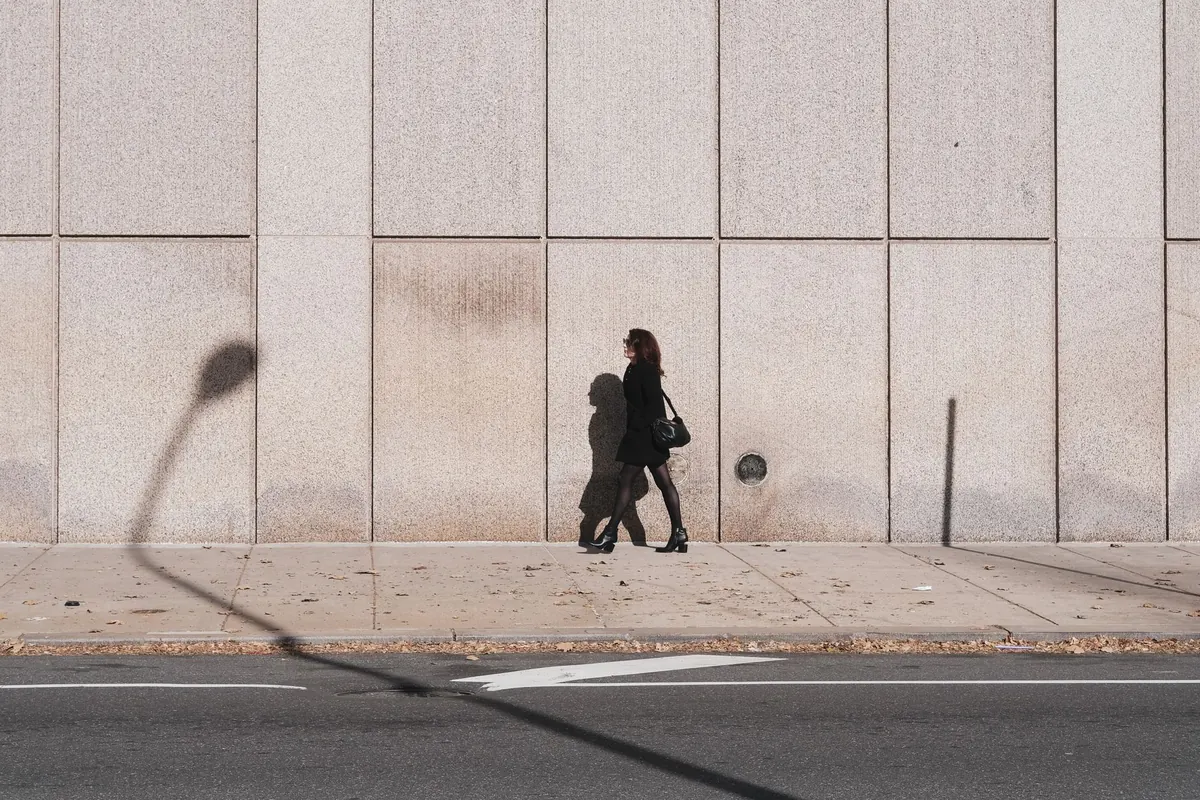
Photo: Garrison Gao / Pexels